

Articles
ErgoS anniversary: 20 years of Human Factors in ship design
In 2020 it is twenty years since ErgoS was invited to design the bridge of the worlds largest dredging vessel. That was the start of two decades of ship innovation by applying ergonomics principles and design tools, in which we contributed to the design of more than 25 ships: dredging vessels, crane ships, pipe layers, cable layers, cargo ships, FLNG’s, FPSO’s, tankers, patrol vessels and many others.
The involvement is not only about ‘bridge ergonomics’ anymore, as we also design crew plans, user interfaces, ECR’s, crane cabins, living quarters, crew cabins, furniture, galley’s, recreation rooms, way-finding and much more.
To celebrate this event, we intend to publish a series of articles about our practical experiences with Human Factors in relation to ship design and ship innovation. Some of these articles will look back, some will certainly look forward, some will be about global issues and some about design details. There is plenty of material, since Human Factors and ergonomics still have a lot to offer to the world of ship design.
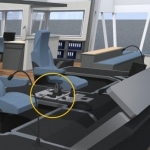 Human Factors perspective on ships steering control
Here is the first of a series Human Factors articles as mentioned in our anniversary announcement. It is about a typical ‘design detail’ of a ships bridge. Hope you enjoy it. I look forward to your reactions.
Special thanks to capt. Levien Bijl (master at Fred Olsen) and Hans Dijkerman (Electric and instrumentation specialist at van Oord MC) for their valuable input!
The next article in the series ’20 years of human factors in ship design’ will be published July/August 2020.
Other articles
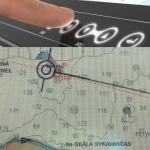 Human perception problems of ECDIS electronic chart displays
Recently the Dutch Safety Board (Onderzoeksraad voor veiligheid) published an interesting report about a grounding incident of the Dutch cargo vessel Nova Cura. On the 20th of April 2016 the ship hit a reef in the Mytilini Strait in Greece. No casualties were reported, but the ship was total loss. It appeared that the ECDIS (Electronic Chart Display and Information System) indicated a depth of 112m at the grounding location, whereas the actual vessels draft was 5.8m.
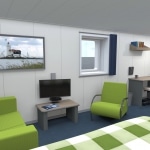 Cabin innovation by Human Factors design
Main purpose of crew cabins on a ship is to provide a comfortable and quiet place to sleep. Single-person cabins, both thermal and acoustic insulated, with good quality matrasses are now standard in shipbuilding. Apparently this basic requirement is covered yet, so what is the next step?
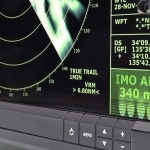 When to use marine-spec displays?
On ships we find two types of computer displays: standard ‘office’ displays (brand names like LG, Dell, HP, Samsung, IIyama) and ‘marine specification’ displays (Hatteland, Isic, Nottrot, and some others). At first glance they look quite similar, until you have a look at the price tag: the marine spec displays easily cost three times as much as an office quality display of similar size and resolution. So what is the difference, and in which case you should use specifically marine spec monitors?